The Fiancé Factory: How a Romance Scam Gets Built
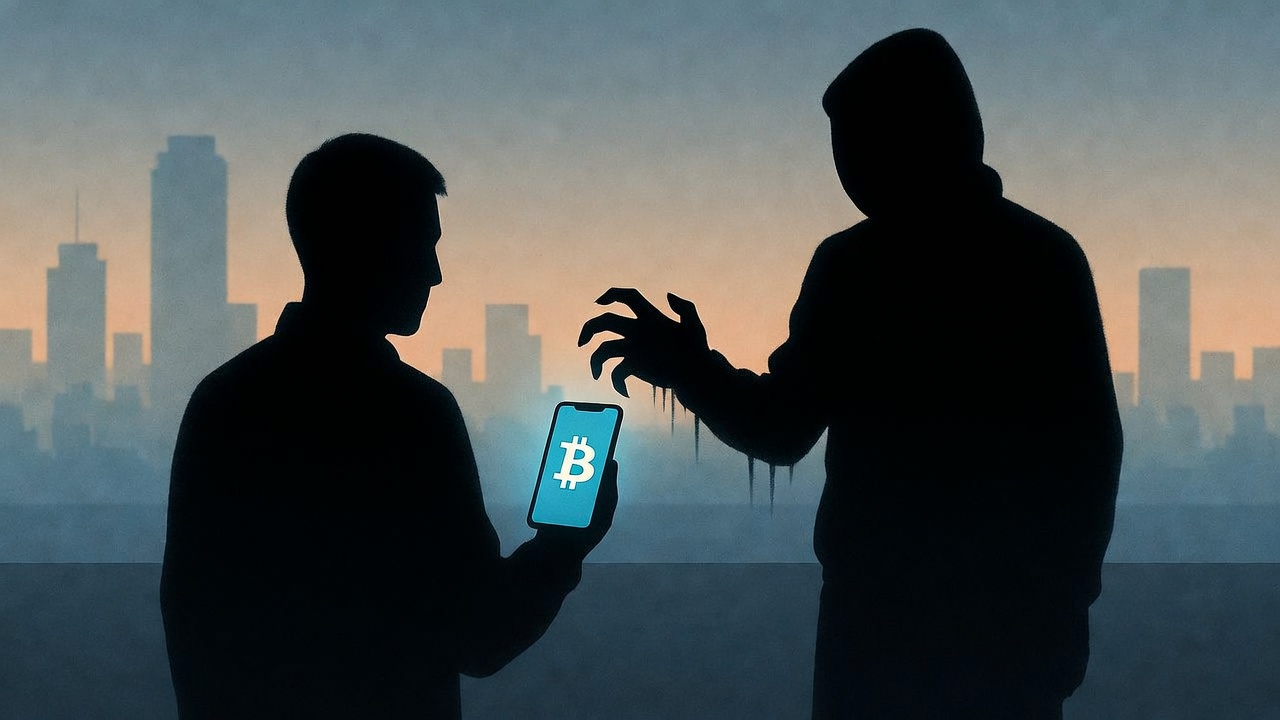
The message arrives in the evening, after the house has gone quiet. The profile photo shows a man of a certain age in a hard hat, a steel derrick rising behind him. He writes that he came across her profile by accident, that something made him stop, that he apologizes for being forward. Three weeks later he is the first person she says good morning to and the last one she tells good night. Three months later the savings account is empty. This piece is not about the fact that such things happen. It is about how they are made: station by station, on an assembly line.
A serial product, not an accident
Begin with scale, because scale changes the optics. According to the F.B.I.’s Internet Crime Complaint Center report for 2025, the bureau logged 1,008,597 complaints, with reported losses above $20.8 billion, a jump of twenty-six per cent in a single year. The confidence-and-romance category accounted for some $929 million across 23,159 complaints, a thirty-eight-per-cent rise in losses. The largest single line item was investment fraud built on cryptocurrency, the scheme known as pig butchering: $7.2 billion. A broader crypto descriptor, which counts every complaint in which cryptocurrency merely served as the payment rail, reached $11.37 billion, up twenty-two per cent in a year; the two figures are worth keeping apart, because only the first describes the mechanism at issue here. And these are the cases reported in one country. Researchers agree that most victims never report at all.
Numbers like these are not produced by lone charmers. They are produced by organizations. The United Nations Office on Drugs and Crime, in its Inflection Point report of April, 2025, describes hundreds of industrial-scale scam centers in Southeast Asia generating close to forty billion dollars in annual profit, staffed largely by people who were themselves recruited under false pretenses and are held by force, each running dozens of conversations at once from prewritten scripts; a threat assessment published in July, 2026, put losses from cyber-enabled fraud in 2025, in East and Southeast Asia together with Australia and New Zealand alone, at anywhere from $8.3 billion to $114.1 billion; the width of that range is itself a measure of how hard this economy is to see. There are dialogue manuals, photo libraries, catalogues of ready-made documents, one department for payments and another for laundering. To ask how a romance scam is built, then, is to ask about a production process: casting, script, set design, distribution, monetization. It pays to walk the line station by station, because a serial product has serial features, and serial features can be recognized.
Casting: where the perfect partner comes from
The persona is the project’s first asset, and it is built to fit the victim, not the truth. The photographs are lifted from other people’s profiles or from stock agencies; now and then, in a hurry, the operators send an image with the agency’s watermark still visible, which is about the cleanest proof of fabrication a case file can hope for. The biography is chosen to impress and to explain unavailability in the same breath: an engineer on an offshore rig, a military doctor on deployment, a widower on a foreign contract. There is nothing accidental in this poetics. The profession has to do three jobs at once. It must explain why a meeting is impossible, why the camera never works, and why the hero’s considerable fortune is temporarily frozen.
Around the persona comes the contact infrastructure. Messenger accounts are often registered as business profiles, because the business badge lends credibility, and phone numbers are registered in the victim’s own country, so that nothing squeaks. In the more baroque variants the victim herself, asked for a small favor, buys and tops up a SIM card for her beloved; from the organization’s point of view this is an elegant maneuver, since the formal trail of the number now leads to the victim rather than the perpetrator. The same pattern, shifting the traces onto the injured party, will return later, when the money moves.
The script: a grammar of feeling, written on a keyboard
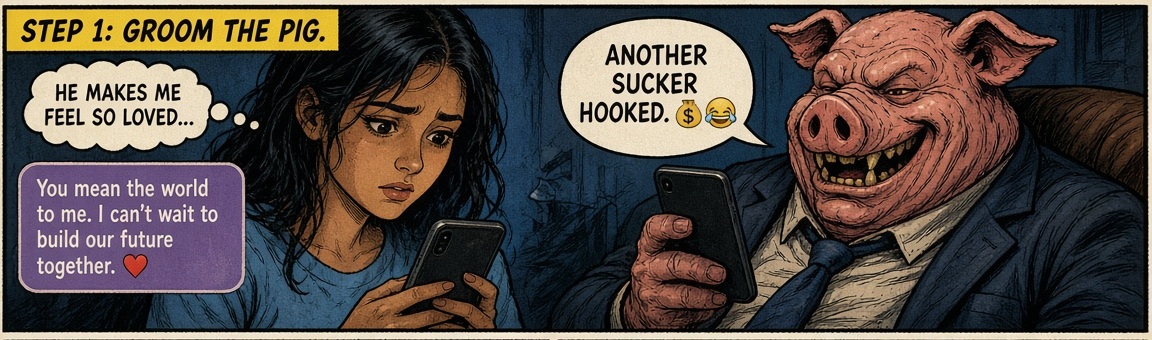
Monica Whitty, a cybercrime researcher and the author of a staged model of scammers’ persuasion published in the British Journal of Criminology (The Scammers Persuasive Techniques Model, 2013), showed that the relationship is engineered methodically, long before the first request for money. First comes the flood of attention and tenderness known as love bombing: dozens of messages a day, morning and bedtime rituals, early declarations that this is something rare. Then the conversation is moved into a single channel and the surroundings are gently trimmed away, because friends and family are, to a scriptwriter, risk factors. Then comes the testing of the ground with small requests that cost nothing but teach obedience to requests as such. An independent 2025 study that dissected the life cycle of pig-butchering operations, built on real case data, maps the same choreography of stages at industrial scale.
The psychology of remote communication plays for the house. Classic studies of text-based intimacy found that writing invites idealization: we fill the gaps with our own longings, and a carefully edited message reads as deeper than ordinary talk. George Loewenstein, who described the gap between our cool judgment and our heated decisions (the hot-cold empathy gap, demonstrated originally on medical choices), showed how strong affective states, desire, fear, longing, narrow the field of decision and crowd out the calculus of risk. The scam script is a machine for producing such states on demand. Meanwhile a quiet financial reconnaissance is under way: questions about the house, the mortgage, the savings, the dates when benefits arrive sound like tenderness and function as inventory. Case files later reveal a detail that is hard to forget: payment schedules laid out at two-week intervals, tuned precisely to the rhythm of the victim’s welfare deposits. The organization never demands sums the victim does not have. It demands exactly the sums she does.
Set design: paper, rubber stamps, and a client dashboard
Once the relationship is ready, the scenery rolls in. The factory keeps a props department: receipts from fictitious courier companies, certificates of deposit with seals and signatures, permits from foreign courts, wire confirmations wearing bank logotypes, none of which would survive five minutes of verification and none of which has to, because it lands in the inbox of someone who is in love, exhausted, and cut off from second opinions. A prop of its own class is the fake platform: a client dashboard on which a balance grows. The balance is a number on a screen, nothing more, but it performs the crucial dramaturgical function that Whitty, in the same paper, called the near-win. The victim sees a fortune at arm’s length; every further fee looks like the last meter of the road rather than the next meter of the bog. Withdrawal from such a panel never succeeds. Every attempt at withdrawal, however, reliably produces a new fee: a tax, a commission, a certificate, an act of legality. The name of the document varies. The function never does.
Crisis dramaturgy: the parcel, the customs office, the inheritance
Static scenery is not enough; a plot needs conflict. Sooner or later the script introduces a crisis with a clock: a package of great value detained at an airport, a bail the hero cannot cover, a sudden operation, a frozen account. The inheritance variant adds a dying benefactress, a court document, and a transfer waiting on a modest processing fee. The construction is always three-layered. There is time pressure, which switches off deliberation. There is a threat, often legally absurd and emotionally effective, say, the suggestion that the victim herself will face prison for the contents of the box. And there is an escape hatch in the form of a specific sum payable today. Behaviorally this is a textbook: loss aversion, described by Kahneman and Tversky in prospect theory, makes us defend what is supposedly already ours, and the sunk-cost trap, documented in Arkes and Blumer’s classic The Psychology of Sunk Cost and in decades of later research, makes us pay again so as not to void what we have already paid. The more someone has put in, the harder it is to stop; walking away would mean admitting that everything so far was a mistake, and the mind defends itself against that admission with everything it has.
Monetization: where the money actually goes
The audience watches the stage; the box office stands to the side. The first payments usually travel by ordinary transfer to a bank account in the victim’s own country, opened in the name of a money mule, someone who rents out an identity for a small fee or out of desperation; the funds leave the account within hours. Then the repertoire widens: gift cards whose codes travel by message and cannot be clawed back, card purchases of cryptocurrency through legitimate payment processors, and finally an exchange account opened in the victim’s name and quietly linked to the organization’s wallets, so that every deposit drains outward on its own. Here the pattern from the casting stage closes its loop. Identity documents, extracted early under the pretext of booking a ticket or clearing a parcel, now serve to make the formal trail of the flows point at the victim. Blockchain analysts give a sense of the outflow: TRM Labs’ 2026 crypto-crime report estimates that roughly $35 billion moved to fraud schemes in the course of the year. She is at once the source of the money and the smoke screen for its laundering; in Polish criminal law the pattern engages, all at once, Article 286 of the Criminal Code (fraud), Article 190a § 2 (identity theft), and Article 299 (money laundering), and for the victim it is a reason to see those operations formally attributed to the perpetrators as fast as possible.
The last act: gleaning, and the second life of the list
The finale comes in two movements. First the gleaning: when the victim says there is nothing left, the organization proposes a loan, an installment sale of her phone, help with the paperwork for a payday lender. This is the moment when the script stops pretending to be a romance and starts to resemble a foreclosure conducted in endearments. Then, after contact breaks, the second movement: a call or an e-mail from a supposed firm, foundation, or agency that will recover the lost funds for a fee paid up front. Lists of victims circulate in this economy as a commodity in their own right, and the research of Whitty and Buchanan on the double hit (2012), whose psychological consequences they developed in a 2016 study, explains why this phase is often the cruelest: a person wounded financially and emotionally will grasp at any hope, and so pays once more, this time for the promise of repair. We have dissected the secondary industry in a separate piece on the recovery scam; here one sentence of principle will do. No honest actor guarantees the recovery of your money, and no honest actor charges for it in advance.
How to spot factory work
Serial production leaves structural traces, and it is the traces one should watch, rather than trusting an intuition that has just been hacked. First, the channel: the relationship bolts quickly into a single messenger, and the meeting, like the video call, is always one step away and never today. Second, the biography: the partner’s profession structurally prevents verification and structurally justifies the future requests for money. Third, the props: documents with seals that no one on earth sends as photos in a chat, wire confirmations from unfamiliar banks, balances that grow only on the screen of a platform no financial regulator has heard of. Fourth, the economics: every withdrawal breeds a fee, and the installments fit the rhythm of your income suspiciously well. Fifth, the signature requests: a SIM card for him, gift cards, help receiving a parcel, a small commission on an enormous gift. Two minutes with a reverse image search can unmask a casting photo, and one call to a bank or a lawyer can stop the script between acts. Above all, one rule: a real feeling survives verification, a false one begins to forbid it.
If the script is already running
If this description sounds familiar, the order of operations is as follows: break contact without announcing it, delete nothing, because screenshots, transfer confirmations, account numbers, and wallet addresses are tomorrow’s evidence, alert the bank to the possibility of freezing funds on the recipient’s side, flag your identity documents if copies have reached the scammers, and file a written criminal complaint with the prosecutor’s office, with concrete evidentiary motions, because an oral report at a police station goes missing too easily. Money is recovered rarely, and no honest person will guarantee it, but a fast, properly constructed complaint improves the odds of a freeze at the mule account and, just as important, formally assigns to the perpetrators the operations performed in the victim’s name. Skarbiec Law Firm represents victims of online fraud, from the analysis of evidence to representation before law enforcement; if you need help, write to us before someone does who promises to get everything back.
One sentence, in closing, worth remembering in place of the whole article. The victim does not lose to a stranger’s charm; she loses to a script department, a props department, and a payments department that have been working her case full time for months. You do not beat a factory with personal magnetism. You beat it with procedure.

Robert Nogacki – licensed legal counsel (radca prawny, WA-9026), Founder of Kancelaria Prawna Skarbiec.
There are lawyers who practice law. And there are those who deal with problems for which the law has no ready answer. For over twenty years, Kancelaria Skarbiec has worked at the intersection of tax law, corporate structures, and the deeply human reluctance to give the state more than the state is owed. We advise entrepreneurs from over a dozen countries – from those on the Forbes list to those whose bank account was just seized by the tax authority and who do not know what to do tomorrow morning.
One of the most frequently cited experts on tax law in Polish media – he writes for Rzeczpospolita, Dziennik Gazeta Prawna, and Parkiet not because it looks good on a résumé, but because certain things cannot be explained in a court filing and someone needs to say them out loud. Author of AI Decoding Satoshi Nakamoto: Artificial Intelligence on the Trail of Bitcoin’s Creator. Co-author of the award-winning book Bezpieczeństwo współczesnej firmy (Security of a Modern Company).
Kancelaria Skarbiec holds top positions in the tax law firm rankings of Dziennik Gazeta Prawna. Four-time winner of the European Medal, recipient of the title International Tax Planning Law Firm of the Year in Poland.
He specializes in tax disputes with fiscal authorities, international tax planning, crypto-asset regulation, and asset protection. Since 2006, he has led the WGI case – one of the longest-running criminal proceedings in the history of the Polish financial market – because there are things you do not leave half-done, even if they take two decades. He believes the law is too serious to be treated only seriously – and that the best legal advice is the kind that ensures the client never has to stand before a court.